I write this standing in front of an empty plot of land on Knob Hill. Some way off in front of me, and a little to my right, stands the regal face of the Colorado School for the Deaf and the Blind. Behind me, off to my left, is the even more imposing presence of the Union Printers Home. Ahead of me, in the distance, I can see Pikes Peak beyond the trees. They say Knob Hill is the highest local point. I suppose the mountain was an obvious exclusion.
But I care little about the lofty peaks ahead of me, or the man-made ones to my right or to my left, though they are all built from the same beautiful rust-colored stone. I’m here to see the place where an ugly wooden building once stood, the place where five years ago I came looking for a man who was said to do the impossible.
I was not a man who tended to believe in the impossible, or even the incredible. I have spent too much of my life lying about those very things to trust other men’s accounts. Pictures, the evidence the public trusts above all – those I doubt most. Because I know how to lie with them. My career as a stunt photographer has hinged on that skill. Nothing in real life looks as stunning, as awe inspiring, as the things you can create with a camera and the willingness to rewrite the truth.
At least that was what I believed on that day in 1899 when I arrived here to take a picture of Nikola Tesla for Century Magazine.
If I close my eyes to the barren land where the Tesla Experimental Station once stood, I can still see it: a bulky, out-of-place building, like a huge barn with a web of metal scaffolding balanced precariously on top. And of course, high above it all, like a 150-foot tall sewing pin pierced delicately and precisely into the center of the web, the radio antenna. That first day that I came here, I remember craning my neck to look up at it as I approached the building, wondering… I don’t know what. Just wondering.
I can see it all so clearly, so sharply, that it’s like I’m really there, like I’ve just knocked on the door and I’m standing there with my camera in my hands, waiting for someone to answer.
I’m already composing shots in my head. Tesla is famous for incredible displays with electricity. With my expertise at embellishing, I could have something sensational. A double exposure, maybe? Tesla standing next to one of his famous coils, catching a bolt of lightning in his hand? A picture like that would do wonders for Tesla’s publicity… and for my paycheck.
Still no one has answered. Impatient to realize my vision, I push on the door and find it unlocked.
I step inside. The first thing I notice is the sound, an odd metallic buzzing sound. The second thing is the lightning.
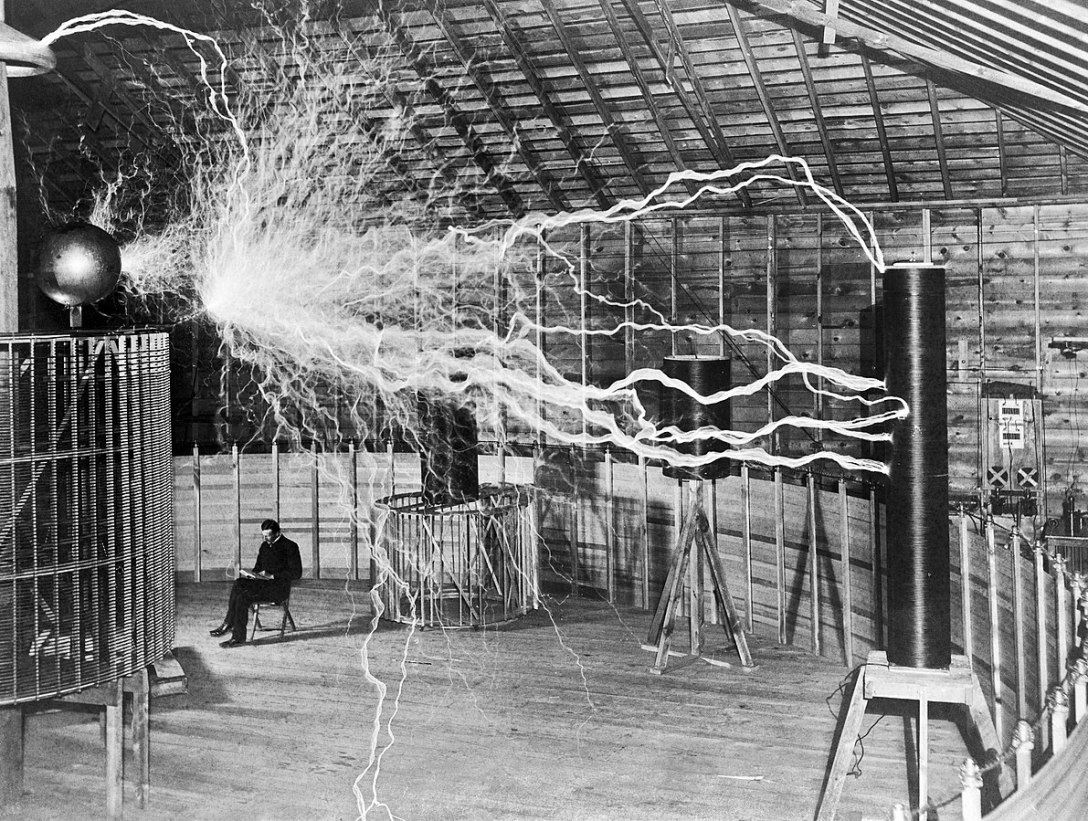
The entire interior of the building is one huge, dimly lit room, and in the center is something like a round pen, created by a six-foot-tall wooden fence. Along the top of the fence a wire runs, suspended by metal posts that look as if they run down into the ground.
But I hardly see the fence, except as an obstacle to where I want to be. Looming over the fence are huge metal towers, not precarious and haphazard like the things on top of the building but elegant, massive, heavy things. Upright cylinders wrapped completely in beautiful copper stand around a central tower with a silver ring at the top. A strange basket-like grid surrounds the tower near its base, and atop the grid are several large silver balls.
It is from these the electricity comes. I stand for a moment, awed despite myself. It looks like lightning, exactly like lightning. It’s purple-white and shifting erratically, continuous but fluid. The room is lit with a flickering light.
I want to get closer, but I don’t know if can or if it’s even safe. The electricity, though jumping from coil to coil, seems confined within the pen by the fence somehow. I notice a small set of stairs that leads to some kind of ledge or half-floor running around the building, maybe ten feet off the ground.
Looking around to check that I’m alone, I quickly mount the stairs to the ledge, camera in hand. I turn and raise it to my eyes, snapping a shot of the incredible sight as soon as I see it framed in my viewfinder.
But as I take the picture I see something I don’t expect to see.
Sitting in a chair beside the largest coil, reading a book, is a tall, thin man in a dark suit. He sits there calmly, even as the fingers of electricity crackle deafeningly around him. As he licks his long index finger to turn a page a bolt leaps to it. Yet he continues unaffected.
I marvel. The lightning looks so deadly, yet apparently it’s perfectly safe.
“Mr. Tesla!” I call, raising my camera for another picture.
He looks up. I step forward. But I step forward into nothing, and I fall.
The lightning strikes me before I even hit the ground.
It feels like cold fire, like an ache that runs electric through my body and needles into every bone. My hands, my arms, my legs begin to cramp, and suddenly every part of me is seized with a stiffness too alive to be death. My thoughts are being overwritten, each one going static as I feel the electricity moving up my spine and into every pathway in my brain. My eyes tear up, both from the impact and the seizure of my body by this inexorable force.
In this moment I am helpless. I am not in control. I am in the grip of something a thousand times powerful than me, something so powerful that if it does not let go of me soon it will consume me, body and soul, and leave dust and ash here where I lay. If it does not let me go I will die.
I hear a click, the sound of a large switch being flipped.
All of a sudden the electricity is gone.
For a moment my body is silent. Then the burns and the broken arm start screaming at me.
In my blurry vision I see a tall, thin figure coming to me, standing over me. He extends a pale hand. I grab it with my unbroken right arm. Somehow I can stand, barely.
“I’m sorry,” he says slowly. “If I had seen you coming I would have turned it off.”
I shake my head, lick my dry lips. My mouth tastes sour and metallic.
“How…” I begin slowly, afraid that I will have lost the ability to speak. My head pounds as I forge ahead. “How can you touch it? Why doesn’t it kill you when it would have killed me?”
He regards me softly, quietly, with dark brown eyes that hide an intensity I have never seen in any other man.
“We have much to discuss, Mr…?”
He pauses questioningly. It takes me a moment to realize he wants my name.
“Alley,” I say quickly. “Dickinson Alley.”
He raises his eyebrows in recognition.
“The photographer from Century Magazine.” He nods. “Well, we must talk. Are you all right?”
“Actually…” I look down at myself. Other than the burns on my hand, the broken arm, and several charred places on my clothes, I’m shockingly, unbelievably okay. “It seems like I’ll make it.”
“Ah.” He turns, a sad look in his eyes. “Yes, externally it would not do much damage, but the internal consequences…” He begins to walk away from me. After a moment I follow.
“The internal consequences,” he continues without looking back, “are not so easily seen.”
“Internal consequences?” I don’t like the sound of this.
Tesla makes his way to his chair, picks up his book, carefully dog-ears the page and closes it. He turns toward me, a strange-half smile on his face.
“Mr. Alley, if you want answers you must make a choice.”
He gestures towards the coils, standing silent and unassuming beside us.
“I will tell you what you want to know. About me, about my work, about the strange difference between us.” He runs his long fingers along a crease in his suit jacket as if straightening it. “I will ask you not to tell anyone else.”
I frown.
“What? I-”
He holds up his hand.
“I can give you another story for your editors at Century Magazine. Something they will believe.”
I think for a moment.
“How do you know I won’t just tell them anyway?”
He smiles again.
“I don’t.”
I think about the money I would get if I took my story to Century. It’s incredible, unbelievable.
But something in Tesla’s eyes tells me I’m not going to do that.
“Alright,” I say. “Try me.”
I won’t tell you what Nikola Tesla told me. I like to be known for keeping my promises.
Yes, I used the picture I took in the article. But no one knows the real reason why Tesla can sit there unharmed. I’ve spread a rumor that it’s a double exposure, my old favorite way to fake a photo. If anyone questions the possibility of a normal man sitting within a lightning storm, the “truth” about my falsehood will be enough to convince them. I know it would have been enough to convince me.
But I will tell you, as I stand here on Knob Hill, that it takes more than that to convince me now that the incredible might not just be true.
Discover more from Off and On Stories
Subscribe to get the latest posts sent to your email.


